Founding registrations open July 1, 2026. Explore the registry and survey your parcel now — accounts and claims open July 1.
The Frontier Library · Deep dive
Can a drone fly on Mars? Yes — but it has to be a different machine.
Powered flight on another world stopped being theoretical in 2021. The hard part was never the idea — it was building something that can claw lift out of air a sixtieth as thick as ours, survive nights at −90 °C, and fly itself with a twenty-minute radio delay to the nearest pilot. Here is how a Martian drone actually works, what the next generation will do, and why an aircraft like this is the natural survey instrument of the next frontier.
By the Red Homestead Registry~16 min readJune 2026
🛰️
This is a plain-English engineering explainer, drawn from NASA/JPL's published mission record. It explains the technology of the Martian frontier — it is not a claim that any authority will recognize off-world land. No legal title is conveyed on the Moon or Mars today.
The question "can a drone fly on Mars?" has a clean, settled answer, and it is yes. We know because one did — many times. On 19 April 2021, a four-pound helicopter named Ingenuity lifted a few feet off the floor of Jezero Crater, hovered for thirty seconds, and set itself back down. It was the first powered, controlled flight by an aircraft on another world — a Wright-brothers moment performed 170 million miles from Kitty Hawk, by a machine carrying a scrap of fabric from the original 1903 Flyer's wing.
Ingenuity was built as a technology demonstration. JPL designed it for five short test flights and hoped it would survive thirty days. It flew 72 times over nearly three years, travelled more than ten miles, scouted routes for the Perseverance rover, and only stopped in January 2024 when a hard landing damaged its rotor blades. By any standard it was one of the great overachievers in the history of spaceflight — and every flight after the fifth was teaching engineers something they will pour into the bigger, more capable Martian aircraft now being designed.
So flight on Mars is real. The interesting questions are the ones underneath it: why is it so brutally hard, and what does a machine have to become in order to do it? Almost every assumption baked into an ordinary Earth drone is wrong on Mars, and the corrections are extreme.
Part two
The thin-air problem — the one number that explains everything.
If you remember a single fact about flying on Mars, make it this one: the Martian atmosphere is roughly one percent as dense as Earth's at sea level — about a sixtieth. The surface pressure is around 6 millibars, against our 1,013. A rotor, a wing, a propeller — every aircraft on Earth makes lift by throwing air downward, and a Martian rotor has almost no air to throw. Standing on the surface of Mars, in terms of the stuff a wing can grab, is aerodynamically like flying at about 100,000 feet on Earth — roughly three times higher than a cruising airliner, well above where any helicopter can hover.
Two other numbers bend the problem, one for better and one for worse. Gravity helps: Mars pulls at only 38% of Earth's, so a given craft weighs far less and needs less lift to hold itself up. Sunlight hurts: Mars sits half again as far from the Sun, so a solar panel there collects under half the energy it would at home — and that thin power budget shapes the whole machine. Put the three together and you have the Martian flight environment in one picture:
The Martian deal. One factor helps and two hurt — and the one that hurts most, air density, dominates everything. A Mars drone is, at heart, a machine engineered around a near-vacuum.
That sliver of a density bar is the whole story. Every strange thing about a Martian aircraft — the enormous blades, the dishwasher-on-spin-cycle rotor speed, the obsession with weight — is a different answer to the same question: how do you fly when there is almost nothing to fly on?
Part three
Five ways a Mars drone has to be a different machine.
Take a capable Earth drone to Mars and it would simply sit there, rotors howling, unable to leave the ground. To fly, almost every system has to be re-thought. These are the five that matter most.
01
Huge blades, spun absurdly fast
With so little air to bite, the rotor has to move a great deal of it very quickly. Ingenuity's two counter-rotating blades spanned about 1.2 metres to lift a craft the size of a tissue box, and they turned at roughly 2,500 rpm — about five times faster than a full-size Earth helicopter's rotor. Big, light, and frantically fast is the Martian rotor's signature.
02
It has to survive the cold
Martian nights fall to around −90 °C. Batteries, electronics and motors would freeze and crack. Ingenuity spent most of each night's stored energy not flying but running heaters just to keep its own guts alive until morning. On Mars, surviving the dark costs more than flying in the light.
03
It must fly itself
Radio takes 4 to 24 minutes to cross from Earth to Mars, one way — no one can pilot it live. And there is no GPS. The drone navigates by looking straight down, tracking surface features with a camera and inertial sensors, and runs its own hazard-avoidance. Every flight is fully autonomous; the humans only set the goal.
04
It makes its own power
There is no charger on Mars. A roof-mounted solar panel tops up the battery between flights — slowly, because sunlight is weak and dust dims the panel a little more each day. That trickle sets the rhythm of the mission: short flights, then long recharges.
05
It has to beat the dust — and ride the wind
Martian dust is fine, dry and electrostatic; it clings to panels, optics and bearings and never fully washes off. And while the thin air can't lift much, it can still push — seasonal winds and dust devils shove a feather-light aircraft around, so the flight controller has to be far more aggressive about holding position than anything on Earth needs to be. Lightweight enough to fly, but tough enough not to be blown away: that contradiction is the Martian engineer's daily problem.
One detail captures how tight the margins are. To save precious weight, Ingenuity did not fly a hardened, space-rated computer — it flew a commercial Qualcomm smartphone processor, the kind of chip you'd find in a 2014 Android phone, because it was light, cheap, powerful, and good enough. On Mars, every gram is the enemy, and clever beats heavy.
Part four
Why "just spin faster" hits a wall.
If thin air means less lift, the obvious fix is to spin the rotor faster and faster until you claw back what you've lost. Mars engineers do exactly that — up to a hard physical ceiling they cannot cross.
Five times faster — and that's about all you get. Past a certain speed the blade tips approach the local speed of sound, where shock waves form and the rotor loses efficiency instead of gaining it. The thin, cold Martian air actually lowers the speed of sound, so that ceiling arrives sooner. You can't simply spin your way out of the problem.
This is why Martian rotorcraft can't just keep scaling rpm, and why designers are forced into other tricks: more blades, bigger blades, and specially shaped airfoils tuned for the strange, syrupy-yet-thin flow regime of Mars — closer in character to how an insect's wing works in our air than to a normal propeller. The next generation of Mars aircraft is largely a series of answers to this single ceiling.
A Martian drone is what you get when you take every shortcut an Earth aircraft relies on — thick air, a live pilot, GPS, a power outlet, a warm night — and remove all of them at once.
Part five
The drones now on the drawing board.
Ingenuity proved the concept; the machines being designed now are built to do real work. The clear trend is away from the small, twin-rotor scout and toward larger, multi-rotor aircraft that can carry science instruments, range much farther, and even fetch and carry physical objects.
2021Flown
Ingenuity. First powered flight on another world. A ~1.8 kg twin-rotor tech demo — designed for 5 flights, retired after 72.
2024Retired
Grounded. Rotor-blade damage on a hard landing ended the mission after nearly three years — leaving a deep dataset for everything that follows.
~2028Planned
Sample Recovery Helicopters. Two Ingenuity-class craft proposed for the Mars Sample Return campaign — but upgraded with wheels and a small gripper arm so they can land, drive, pick up sealed sample tubes, and fly them back. Flight plus fetch-and-carry.
ConceptIn study
Mars Science Helicopter. A car-of-the-future leap: a six-rotor hexacopter roughly the size of the rover, designed to carry several kilograms of instruments and fly higher and farther than Ingenuity ever could.
2025Unveiled
"Skyfall." An industry concept (from Ingenuity's co-developer) for a single lander that releases a small swarm of scout helicopters to map terrain and scout landing sites ahead of human crews.
The throughline is ambition: from a thirty-second hover to a fleet that maps a region, retrieves cargo, and goes ahead of astronauts to read the ground before anyone risks a boot on it. Which leads to the part of this story that actually concerns a registry like ours.
Part six
The survey instrument of the next frontier.
Read our long-read on where land title comes from and one tool shows up on every frontier before any deed does: the survey. You cannot claim, describe, defend, or hand on a piece of ground you cannot measure. On the American plains that instrument was the surveyor's brass transit and chain. On the next frontier, the instrument that measures, maps, and watches the ground will, increasingly, fly.
A drone is the natural surveyor of Martian land. It can photograph a parcel from above at far higher resolution than any orbiter, build a precise terrain map, return on a schedule to record how the same ground changes over time, and document improvements — a habitat raised, ice tapped, a plot worked — with timestamped imagery from directly overhead. Everything the old Land Office wanted from a survey and a witness, an aircraft like this can gather and bring home.
We want to be exact about what that does and does not mean, because honesty is the entire reason Red Homestead exists. A drone cannot create legal title where none can yet exist. The 1967 Outer Space Treaty bars any nation from appropriating Mars, and no sovereign, court, or registry has the jurisdiction to grant ownership of off-world land today — and we never pretend otherwise. What an aircraft like this can do is exactly what the survey always did before the authority arrived: produce the rigorous, dated, defensible record of a parcel and the good-faith work done on it — the documented possession that, on every earthly frontier, was the thing recognition eventually attached to.
That is the whole Red Homestead thesis in one image: the frontier has always belonged to whoever showed up, did the work, and kept the best records. The drone is simply the newest way to keep them.
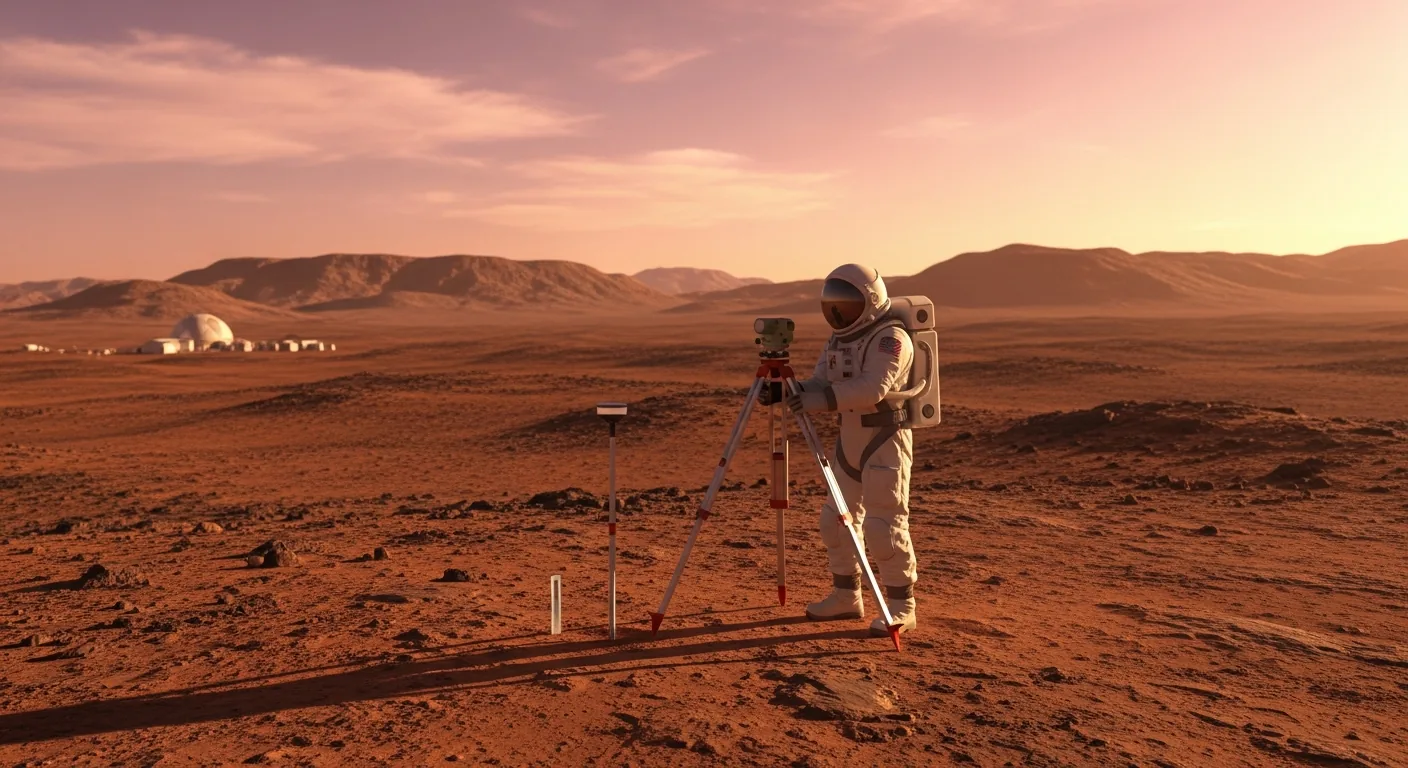
The same act, a new instrument. Measure the ground, occupy it, document it — the oldest gesture toward owning land, repeated on Mars. Tomorrow the transit on the tripod is an aircraft overhead, but the job is identical: turn a place into a record.
Part seven · footnote
Can you even patent a Mars drone?
It's a natural question — if these machines are so novel, is the technology up for grabs? Mostly, no, and the reasons are a small frontier story in themselves.
The ownership puzzle
The aircraft is taken. The method is the open ground.
The core of small-rotorcraft flight is densely patented and already fought over in court. An independent helicopter inventor sued Ingenuity's builder claiming his rotor patents were infringed — and in early 2026 a federal appeals court ended the case in the builder's favor. If an experienced inventor holding real patents can't win on this turf, a newcomer won't either.
There's a deeper catch. When the U.S. government (or its contractors) uses a patented invention, you generally can't stop them — your only remedy is to sue for compensation in a special court, which is precisely the uphill battle just described. And for decades the only "customer" for a Mars drone is a space agency. There is no private market to enforce a patent against.
What that leaves open is not the airframe but the application: novel, specific methods and systems built on top of the aircraft — for example, how autonomous aerial imagery is captured, time-stamped, verified, and turned into a defensible record of a parcel and its improvements. That's the layer where genuine novelty, real enforceability against private actors, and Red Homestead' own interests actually live — and it's a very different question from "patenting a Mars helicopter."
In short: the flying machine itself is crowded, litigated, and largely shielded from private patent claims. The durable, ownable ideas sit one level up — in what you do with the machine. Which, fittingly, is the same place the value has always been on a frontier: not in the surveyor's transit, but in the record it makes.
Technical figures in this article — Ingenuity's flight count, dimensions, rotor speed, processor, and the Martian environment values — are drawn from NASA/JPL's public mission record and standard planetary references, and are summarized and rounded for a general reader. Descriptions of the Mars Sample Recovery Helicopters, the Mars Science Helicopter, and the "Skyfall" concept are of proposed or in-study missions, not committed flights; details and timelines may change. Nothing in this article is legal advice, and nothing in it represents that land on the Moon, Mars, or any celestial body can presently be owned, sold, or legally titled. Red Homestead conveys no legal title and guarantees no recognition of any claim. See our full legal & disclaimer page.
Important legal disclaimer
No conveyance of legal title. The 1967 Outer Space Treaty (Art. II) bars national appropriation of celestial bodies, and no sovereign, court, or land registry currently has jurisdiction to grant or enforce private title to land on the Moon, Mars, or any celestial body. Red Homestead does not and cannot convey legal ownership or any presently-enforceable property right.
What you purchase. A claim-documentation and registry service — the preparation, notarization support, public publication, opposition-period adjudication, and continuous-possession recordkeeping of a good-faith homestead claim — together with a collectible certificate. It is a record of your claim and intent, not a title.
Not an investment; not a security. Your payment is not an investment of money in a common enterprise and carries no expectation of profit from our efforts. We make no representation as to resale value, appreciation, or return. The claim is not offered as a security and is not registered with the SEC, any state securities regulator, or any other authority.
No guarantee of recognition; no sovereignty; not legal advice. We model the process on frameworks in which documented good-faith possession was sometimes later recognized, but we do not guarantee any authority will ever recognize your claim. No Red Homestead claim asserts national sovereignty. Nothing here is legal, tax, or financial advice.
We use cookies and analytics to understand how visitors use this site. You can accept or decline non-essential cookies. See our Privacy Policy.